Blog
The Criminalization of Gender Nonconformity
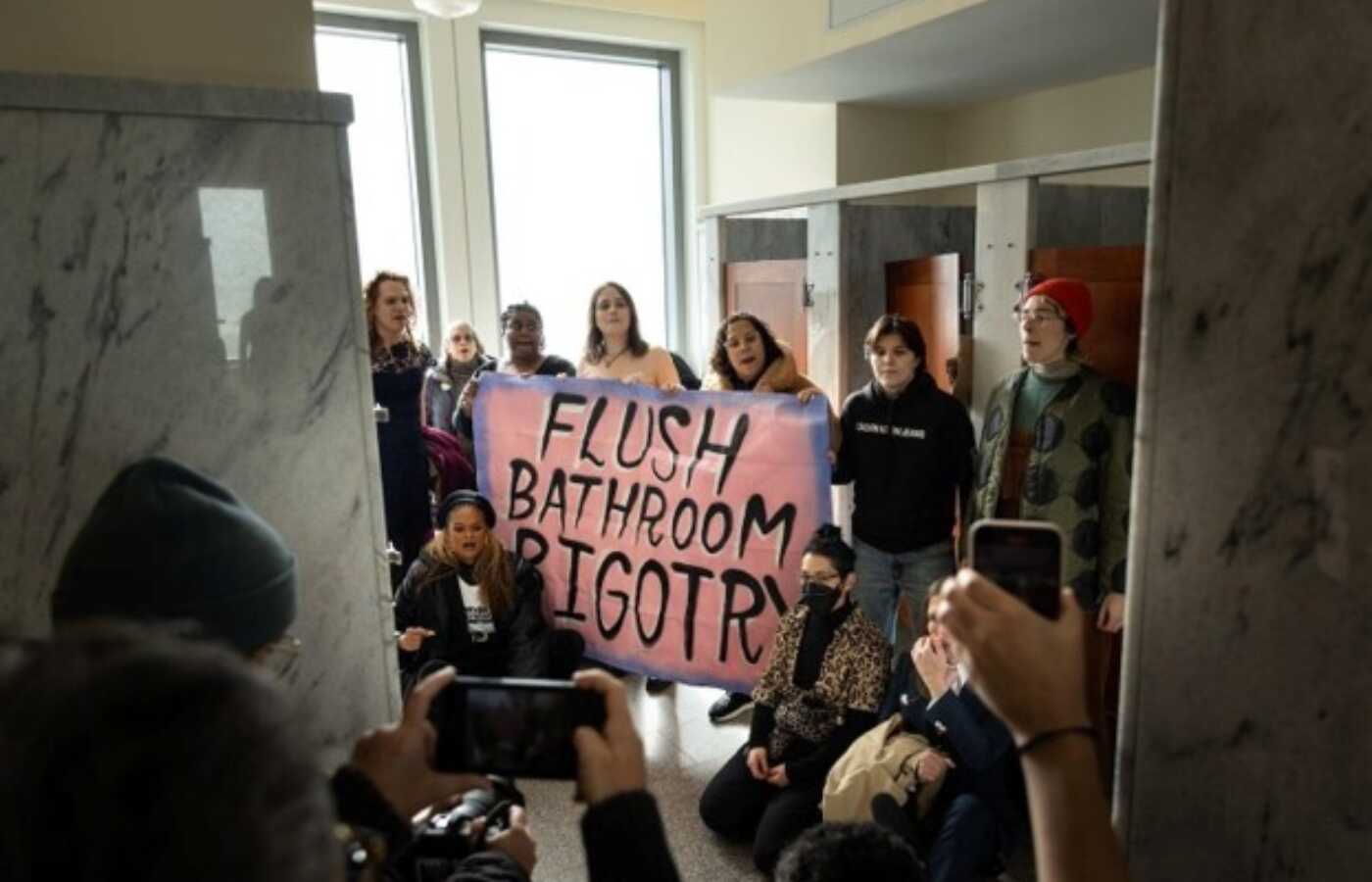
Pro-transgender rights activists with the Gender Liberation Movement protest in the House Cannon building and face subsequent arrests on December 5, 2024 in Washington, DC. Photo Credit: Maansi Srivastava for The Washington Post via Getty Images
There’s a particular kind of harm that doesn’t look like harm when you first encounter it. It shows up in policy language, in bill numbers, in subsections about facility access. It’s easy to miss if you’re not the one it’s aimed at. The laws restricting where transgender people can exist in public are often described as a sudden cultural fight that arrived in the last few years. The specific bills are new. But the mechanism behind them is not.
On February 18, 2026, Kansas lawmakers passed SB 244, which restricts access to bathrooms and locker rooms based on sex assigned at birth and allows private citizens to file lawsuits against transgender people for at least $1,000 in damages if they believe they shared a facility with them.[1] No harm required. No injury, no confrontation, no evidence of wrongdoing. Just the allegation that someone was present who should not have been. Repeat violations can escalate into misdemeanor charges. It turns everyday interactions into potential lawsuits and encourages people to monitor and report each other.[2]
Florida has adopted a similar framework. Under its bathroom restrictions, a person who uses a facility designated for the “opposite sex” can be charged with trespass if they refuse to leave when asked by an authority figure.[3] Using a restroom in a school or public building, something most people do without a second thought, can lead to criminal charges. At the same time, Florida has moved to prevent transgender people from updating the sex marker on their driver’s licenses and has created uncertainty about whether existing documents could expose people to fraud accusations for “misrepresenting” their identity.[4] In both states, the government has attached civil and criminal consequences to living in accordance with one’s gender identity without identifying any independently harmful conduct.
But Kansas and Florida are not outliers. Across the country, lawmakers have introduced dozens of bills targeting transgender people’s access to public accommodations.[5] Montana, Wyoming, South Dakota, Utah, Texas, and Arkansas have also enacted restrictions that prevent transgender people from using bathrooms consistent with their gender identity in government-owned spaces.[6]
These restrictive measures are not limited to states. Recent federal guidance suggests that visa applicants may be required to prove their sex assigned at birth and could face denial or permanent ineligibility for “misrepresenting” their sex if their gender identity does not align with that designation.[7] That means being transgender can be treated as a form of fraud in the context of immigration.
While proponents of these laws often cite “privacy and safety” concerns as their primary motivator, the laws being passed don’t look like laws written by people primarily worried about privacy.[8] A privacy law does not need to authorize private lawsuits over bathroom encounters, nor does it need to prevent individuals from updating the sex designation on their identification documents while simultaneously treating discrepancies on those documents as potential fraud.
And there’s a second effect worth naming: these laws give rise to a culture of body scrutiny, where ordinary people feel entitled to investigate whether someone is transgender based on how they look.[9] In February 2025, a 19-year-old Black cisgender lesbian named Kalaya Morton was confronted in the restroom by two male sheriff's deputies, shining flashlights into her stall, after a Tucson Walmart employee saw her masculine presentation and assumed she was a transgender woman.[10] These laws invite scrutiny of anyone who doesn't look the way the law imagines a man or woman should look — cisgender women who are tall, broad-shouldered, short-haired; anyone whose body doesn't conform to its assigned gender neatly enough for a stranger's comfort.
None of this is new. The government has always found ways to regulate bodies it decided were out of place.[11] The shape of what's happening now becomes a lot harder to miss once you've seen it before.
By the mid-twentieth century, at least seventy municipalities had laws banning cross-dressing, often using language that criminalized appearing in public in clothing “not belonging to [one’s] sex.”[12] These laws were widespread, appearing in large cities and small towns across the country, and they were enforced as part of ordinary policing.[13] In San Francisco, an 1863 law prohibiting cross-dressing led to over one hundred arrests before the end of the century.[14] These statutes were designed to push out anyone who didn't fit a narrow mold, anyone whose identity showed up in how they dressed or carried themselves.
Emma Snodgrass was arrested multiple times in the 1850s for wearing pants in public and was eventually charged with vagrancy.[15] Dr. Mary Walker, a Civil War surgeon, was arrested repeatedly across different cities for wearing pants, her medical credentials and her service to the nation offering no protection against a law that cared only about her clothes.[16]
Authorities justified these arrests by framing gender nonconformity as “disguise,” treating appearance itself as an attempt to conceal identity, even when there was no evidence of deception or harm.[17] New York’s 1845 vagrancy law allowed for the arrest of individuals who were “disguised” in a way that prevented identification, and it was used for decades to target people whose appearance did not align with what was expected of their assigned sex.[18]
In 1890, in San Francisco, Dick/Mamie Ruble was sent to a state asylum for violating cross-dressing laws. They remained there for eighteen years until their death.[19] Others were jailed, fined, or deported under similar legal frameworks.[20]
When the explicit cross-dressing bans eventually faded, the enforcement did not go with them. It simply put on different clothes. Disorderly conduct. Vagrancy. Statutes loose enough to catch whoever the police decided needed catching.[21] Historical accounts describe police enforcing informal rules, such as requiring individuals to wear a certain number of “gender-appropriate” items of clothing.[22] The law relied on an individual officer’s perception rather than explicit gender expression.
The language of the laws may have changed, but not the logic. They reinforce gender norms and expectations not only through enforcement but through messaging, and even laws that are rarely enforced can communicate that certain identities are undesirable and should be regulated. [23] They tell transgender people that their presence is provisional. They tell everyone else that scrutiny is appropriate, that intervention is permitted, that certain bodies moving through public spaces are, by their nature, a problem to be solved.
These laws are not an anomaly but part of a long and well-documented pattern of the government regulating bodies it deems out of place, and transgender people are bearing the consequences.
[1] Kansas Lawmakers Override Gov. Kelly’s Veto of Horrific Bathroom ‘Bounty’ Bill, Human Rights Campaign, https://www.hrc.org/press-releases/kansas-lawmakers-override-gov-kellys-veto-of-horrific-bathroom-bounty-bill.
[2] Id.
[3] Florida’s Trans Bathroom Law Explained, Them,
https://www.them.us/story/florida-trans-bathroom-law
[4] Florida Will No Longer Allow Transgender People to Change Gender on Driver’s Licenses, NBC News,
[5] Legislative Attacks on LGBTQ Rights, American Civil Liberties Union,
https://www.aclu.org/legislative-attacks-on-lgbtq-rights-2026
[6] Bans on transgender people using public bathrooms and facilities according to their gender identity, Movement Advancement Project, https://www.lgbtmap.org/equality-maps/nondiscrimination/bathroom_bans
[7] Marco Rubio May Have Just Banned Trans People from Entering the U.S., Erin in the Morning,
https://www.erininthemorning.com/p/marco-rubio-may-have-just-banned
[8] Rachel Mipro, House Overrides Veto: Bathroom Bill That Limits Access to Kansas Facilities Will Become Law, Kan. Reflector (Feb. 18, 2026), https://kansasreflector.com/2026/02/18/house-overrides-veto-bathroom-bill-limiting-access-to-kansas-facilities-will-become-law/.
[9] Egale Explains: Transvestigation, Egale Canada,
https://egale.ca/awareness/egale-explains-transvestigation/
[10]Christopher Wiggins, Cops Confront Lesbian in Arizona Walmart Restroom After Mistaking Her for a Trans Woman, The Advocate (Feb. 28, 2025), https://www.advocate.com/news/lesbian-mistaken-transgender-arizona-walmart
[11] Kate Redburn, Before Equal Protection: The Fall of Cross-Dressing Bans and the Transgender Legal Movement, 1963–86 (Cambridge University Press, 2023), https://www.cambridge.org/core/journals/law-and-history-review/article/before-equal-protection-the-fall-of-crossdressing-bans-and-the-transgender-legal-movement-196386/B3EDFE10CC12E8BF140359437C0F69BC
[12] Transgender People and Bathroom Access, Advocates for Trans Equality, https://transequality.org/issues/resources/transgender-people-and-bathroom-access#:~:text=In%20fact%2C%20studies%20have%20found,'t%20conform%20%2D%20at%20risk.
[13] Id.
[14] Clare Sears, Arresting Dress: Cross-Dressing, Law, and Fascination in Nineteenth-Century San Francisco (Duke University Press, 2015),
https://www.dukeupress.edu/arresting-dress
[15] Fashion Crimes: The Rabbit Hole of Criminalized Cross-Dressing in U.S. History, Antioch College,
[16] Id.
[17] Id.
[18] Id.
[19] This Isn’t the First Time Conservatives Have Banned Cross-Dressing in America, Jacobin, 2023,
https://jacobin.com/2023/03/cross-dressing-law-united-states-history-drag-bans
[20] Id.
[21] Redburn, supra note 10.
[22] Jacobin, supra note 17.
[23] Drag Queens, the First Amendment, and Expressive Harms, Harv. L. Rev.,
https://harvardlawreview.org/print/vol-137/drag-queens-the-first-amendment-and-expressive-harms/